


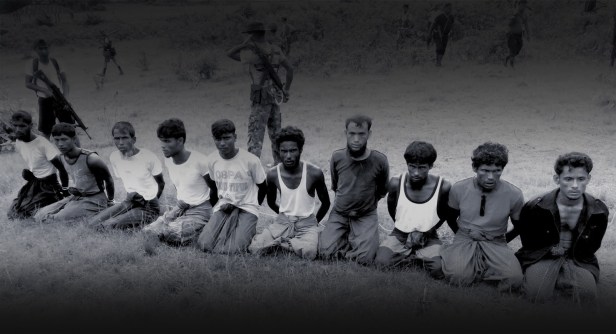
Ten Rohingya Muslim men with their hands bound kneel as members of the Myanmar security forces stand guard in Inn Din village September 2, 2017. Picture taken September 2, 2017. Handout via REUTERS
— Massacre in Myanmar: Myanmar forces burned, looted and killed in a remote village
— Rohingya accuse the army of arson, rapes and killings aimed at rubbing them out of existence in this mainly Buddhist nation of 53 million
— Buddhist villagers and Myanmar troops killed 10 Rohingya men
According to Reuters reports; Myanmar Massacre — how it unfolded.
INN DIN, Myanmar – Bound together, the 10 Rohingya Muslim captives watched their Buddhist neighbours dig a shallow grave.
Soon afterwards, on the morning of Sept. 2, all 10 lay dead. At least two were hacked to death by Buddhist villagers. The rest were shot by Myanmar troops, two of the gravediggers said.
“One grave for 10 people,” said Soe Chay, 55, a retired soldier from Inn Din’s Rakhine Buddhist community who said he helped dig the pit and saw the killings. The soldiers shot each man two or three times, he said. “When they were being buried, some were still making noises. Others were already dead.”
The killings in the coastal village of Inn Din marked another bloody episode in the ethnic violence sweeping northern Rakhine state, on Myanmar’s western fringe. Nearly 690,000 Rohingya Muslims have fled their villages and crossed the border into Bangladesh since August. None of Inn Din’s 6,000 Rohingya remained in the village as of October.
The Rohingya accuse the army of arson, rapes and killings aimed at rubbing them out of existence in this mainly Buddhist nation of 53 million. The United Nations has said the army may have committed genocide; the United States has called the action ethnic cleansing. Myanmar says its “clearance operation” is a legitimate response to attacks by Rohingya insurgents.
Rohingya trace their presence in Rakhine back centuries. But most Burmese consider them to be unwanted immigrants from Bangladesh; the army refers to the Rohingya as “Bengalis.” In recent years, sectarian tensions have risen and the government has confined more than 100,000 Rohingya in camps where they have limited access to food, medicine and education.
Reuters has pieced together what happened in Inn Din in the days leading up to the killing of the 10 Rohingya – eight men and two high school students in their late teens.
Until now, accounts of the violence against the Rohingya in Rakhine state have been provided only by its victims. The Reuters reconstruction draws for the first time on interviews with Buddhist villagers who confessed to torching Rohingya homes, burying bodies and killing Muslims.
This account also marks the first time soldiers and paramilitary police have been implicated by testimony from security personnel themselves. Members of the paramilitary police gave Reuters insider descriptions of the operation to drive out the Rohingya from Inn Din, confirming that the military played the lead role in the campaign.
The slain men’s families, now sheltering in Bangladesh refugee camps, identified the victims through photographs shown to them by Reuters. The dead men were fishermen, shopkeepers, the two teenage students and an Islamic teacher.
Three photographs, provided to Reuters by a Buddhist village elder, capture key moments in the massacre at Inn Din, from the Rohingya men’s detention by soldiers in the early evening of Sept. 1 to their execution shortly after 10 a.m. on Sept. 2. Two photos – one taken the first day, the other on the day of the killings – show the 10 captives lined up in a row, kneeling. The final photograph shows the men’s bloodied bodies piled in the shallow grave.
The Reuters investigation of the Inn Din massacre was what prompted Myanmar police authorities to arrest two of the news agency’s reporters. The reporters, Burmese citizens Wa Lone and Kyaw Soe Oo, were detained on Dec. 12 for allegedly obtaining confidential documents relating to Rakhine.
Then, on Jan. 10, the military issued a statement that confirmed portions of what Wa Lone, Kyaw Soe Oo and their colleagues were preparing to report, acknowledging that 10 Rohingya men were massacred in the village. It confirmed that Buddhist villagers attacked some of the men with swords and soldiers shot the others dead.

1. Abul Hashim, 25
One of the wealthier villagers in the west hamlet of Inn Din – a neighborhood known to the Rohingya as Fosinpara – Abul Hashim ran a store selling machine parts and fishing nets and also stored rice for a nongovernmental organization. He owned a 3-acre plot of trees in the hills near Inn Din that were used as firewood and as construction material. He also had 16 buffalos, which were left behind. “I can’t think why these men were taken. They were all good men,” said his wife of five years Hasina Khatun. They have three children together, including Abdu Majid, born in November in Tenkhali refugee camp in Bangladesh.
2. Abdul Malik, 30
A religious teacher or mullah, he was made the imam at the west hamlet’s mosque in his early 20s in recognition of his teaching ability, according to several residents. The mosque was an old building in the center of the hamlet, but in recent years villagers said they were restricted from using loudspeakers to announce the call to prayer. In addition to teaching, the father of five children ran a small stall where he served tea from a flask, and sold kerosene to fishermen, according to his wife, Marjan, 25. Some villagers remember the stall as a place men would gather to share local news and gossip.
3. Nur Mohammed, 29
He was known by the affectionate nickname “Bangu.” He sold fish and had a small rice paddy field and would grow vegetables and beans in a small garden, according to his wife, Rehana Khatun. “He was only interested in looking after his family. He was hardworking and eager to improve our lot by farming and selling fish,” she recalled.
4. Rashid Ahmed, 18
He was a bright student at Inn Din’s high school, excelling in Burmese and English, according to his parents, father Abdu Shakur and mother Subiya Hatu. His father said he had hoped Rashid Ahmed would go on to become the first person in the family to receive a higher education. “His report card was good. I looked after everything so that he could concentrate on his studies,” said Abdu Shakur, 50.
5. Habizu, 40
He sold fish and kept a small rice field and 15 goats. His wife, Shuna Khatu, 30, is now living in the Balukhali refugee camp in Bangladesh, where she said she has dreamt of Habizu’s return. She gave birth to their third child, baby boy Mohammed Sadek, after she arrived in Bangladesh. Habizu was working and saving toward buying a cow, Shuna Khatu said, and he hoped that he could provide for his children so that they could be educated.
6. Abulu, 17
A student who was about to go into his final year at Inn Din’s high school before violence broke out in October 2016, disrupting daily life across northern Rakhine state. The student, whose full name was Abul Hashim, would go fishing with a net in a pond near their house in the west hamlet, said his mother, Nurjan, 40. He was planning to open up a pharmacy in Inn Din after he finished school, she said. “He was a good boy, always polite,” Nurjan said, breaking into a smile as she recalled an exception: “He liked meat, but he didn’t like dried fish. Whenever I prepared dried fish, he would run off and have dinner that night at a relative’s house.”
7. Shaker Ahmed, 45
He would make about 5,000 kyat ($3.70) each day selling fish, said his wife, Rahama Khatun, 35. “That was good for us. We were well off even with nine kids,” she said. His son and ninth child, Sadikur Rahman, was born in November, after Rahama Khatun arrived at the Kutapalong refugee camp in Bangladesh. “When the kids say where is Dad, I don’t know how to reply,” she said. “Now, I’m feeling very scared. It’s difficult for me to manage everything with nine kids and my husband is not here to help.”
8. Abdul Majid, 45
He ran a small shop selling, among other goods, areca nut wrapped in betel leaves. His wife, Amina Khatun, 40, is now staying in the Tenkhali refugee camp in Bangladesh with their eight children, aged from 1 to 19. “We had to leave six cattle and 3 acres of land, our house and all our belongings,” she said. “It was all lost. I saw it myself – it was burned when we came back to the shore.”
9. Shoket Ullah, 35
He moved to the west hamlet three years ago from Inn Din main village to live with his in-laws after he married his wife, Settara. He was a fisherman and also collected firewood to make extra cash. He was partially deaf since childhood, according to fellow west hamlet residents.
10. Dil Mohammed, 35
He was widely known in Inn Din as “Dilu,” and made a living buying the catch from fishermen who went out into the Bay of Bengal and selling it in Inn Din’s market. He’s known as a sickly man with gastric problems. His wife and 15-year-old son now live in the Balukhali camp in Cox’s Bazar district in Bangladesh, according to fellow former Inn Din residents.
During the reporting of this article, two Reuters journalists were arrested by Myanmar police.
 daybreakonline.news.blog